MCP vs Skill: Who Should Write?
In the process of implementing AI, the choice between MCP and Skill often confuses teams. This article delves into the essential differences between the two: MCP is a stable and reliable atomic interface suitable for fixed requirements, while Skill is a dynamically orchestrated intelligent workflow designed to handle complex scenarios. From technical division to practical paths, we will clarify the core logic of AI capability building and the key battleground for product managers.

Recently, I’ve spoken with many product and development colleagues about AI implementation and found that they are often confused by two terms: MCP and Skill. When a demand arises, which one should be chosen? Who should write it? Is it business development or AI development? Let’s sort this out together.
I will try to explain these two concepts in simple terms and discuss the technical division of labor and practical paths. Enjoy!
1. What are MCP and Skill?
Let’s start with definitions to avoid confusion later.
MCP (Atomic Tool/Interface): Essentially, it is a stable service interface for large model calls, corresponding to fixed requirements, established logic, and atomic capabilities that can be completed in a single step. Its internal structure is stable and does not require dynamic adjustments. For example, queries for store subsidies, product cost inquiries, and policy progress checks are standardized for all merchants, yielding results without the need for additional reasoning from the large model.
Skill (Orchestration Skill): This is a guide for actions that connects multiple MCPs or tools, akin to a flexible and modifiable enhanced workflow. It corresponds to complex demands that require multi-step dynamic orchestration. For instance, generating customized business analysis reports or handling multi-step combined queries necessitates the large model to follow the steps you have outlined.
In summary: MCP is building blocks, and Skill is the blueprint for assembling them.
2. How to Choose: MCP or Skill?
This is the most frequently asked question. My judgment criteria are simple: look at the certainty of the demand.
- Fixed demand, established process → Use MCP
- Dynamic demand, requiring multi-step reasoning → Use Skill
The two do not conflict and can be flexibly chosen based on the scenario. A memorable quote from a meeting is particularly apt: If the process is certain to be executed this way, tell it all, don’t let the large model guess.
There are also differences in calling methods:
MCP calling has two modes. One is hard-coded, where intent recognition matches the corresponding MCP for direct fixed calls; the other is allowing the large model to autonomously match semantics before calling. The output is standardized interface results without the need for additional integration.
Skill calling also has two modes. One is preset Skill mode, where known fixed processes for complex demands are written into Skill, and the large model calls MCPs in the order of orchestration; the other is dynamic orchestration mode, where the large model autonomously breaks down problems and organizes them.
3. Who Should Write? Technical Division of Labor
This section is of great concern to business colleagues.
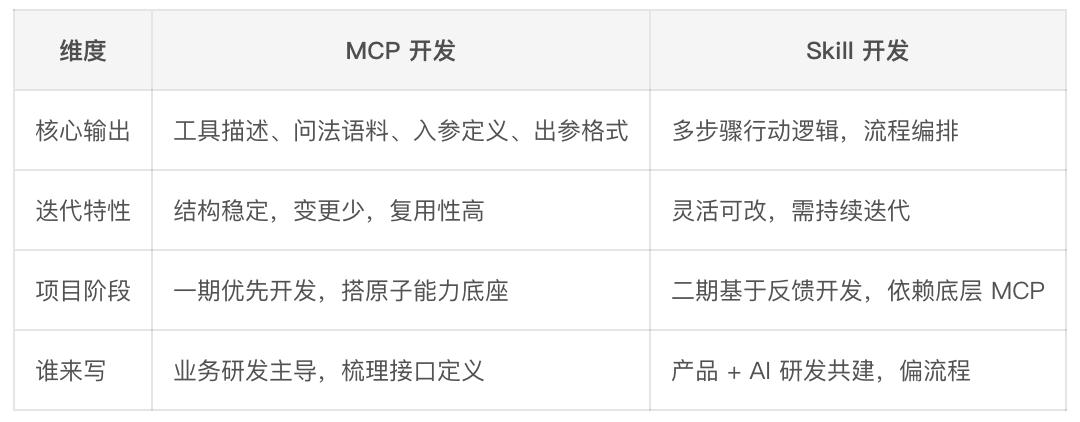
The division of labor is quite clear: business development is responsible for stabilizing atomic capabilities, while product managers and AI developers work together to create Skills. The quality of the description in Skill and the clarity of the steps are areas where product managers can deeply engage.
4. How to Integrate AI into Existing Business
My suggested path is as follows:
Start from existing services or interfaces, connect them with user scenarios to solve specific, determined problems. Then encapsulate MCPs to address flexibility issues. Finally, elevate to Skills to form standard processes.
In short: first run through, then encapsulate, then orchestrate. Don’t start with Skill when the foundation isn’t there; what will you orchestrate?
5. Q&A for Product Managers and Non-Technical Colleagues
At this point, I suspect many non-technical friends still have a lot of questions. Here are some concentrated answers.
Q1: As a product manager, what do these two things have to do with me?
A lot. The function descriptions of MCP, user inquiry language materials, and the steps in Skills are all parts that product managers can influence. The choice of tools by the large model largely depends on how clearly you write.
Q2: Can Skills call MCPs? Can they call regular APIs?
Yes, both. They can be directly written in skill.md or solidified into scripts for calls. Skills are not picky.
Q3: Should all existing business interfaces be encapsulated as MCPs?
It depends on whether they are directly called by the large model. Interfaces not used by the large model do not need to be forcibly encapsulated; don’t encapsulate just for the sake of MCP.
Q4: With many MCPs and Skills, how does the large model distinguish which to use?
By description. The more accurate and clear the tool descriptions and Skill introductions are, the better the large model can judge. This is a responsibility that falls squarely on product managers.
Q5: How to handle compound questions (e.g., “Check if the order enjoys subsidies under a certain policy, and if not, check the reason”)?
For high-frequency common compound demands, create Skills and clearly inform the large model of the steps; for occasional, unpredicted demands, let the large model break down and call autonomously. If it finds value after a few runs, it can be solidified into a Skill.
Q6: If the initial capabilities are all single-step, should I just use MCP?
Yes. Prioritize MCP for the first phase; it is low risk and quick to implement. First, build the atomic capability foundation, and later iterate higher-level Skills based on feedback.
Q7: What if user inquiries match both MCP and Skill at the same time?
If completely left to the large model, it relies on the accuracy of the descriptions; whichever matches better is chosen; if using hard-coded intent recognition, it directly corresponds to the fixed capability without needing the large model to decide.
Conclusion
That’s all about MCP and Skill. Let’s summarize the key points:
- MCP is an atomic tool, corresponding to deterministic demands, led by business development.
- Skill is an orchestration skill, corresponding to dynamic complex demands, co-created by product and AI development.
- Choice depends on demand certainty; if the process is fixed, don’t let the large model guess.
- Implementation path: first run through existing capabilities → encapsulate MCP → solidify Skills.
- The battleground for product managers lies in descriptions and process orchestration, which is key to whether it can run accurately.
Building AI capabilities is essentially a layered task; the foundation must be stable, and orchestration must be flexible. I hope this article helps everyone reduce confusion during the next demand review. If you have any other questions, feel free to leave a message to discuss!
Comments
Discussion is powered by Giscus (GitHub Discussions). Add
repo,repoID,category, andcategoryIDunder[params.comments.giscus]inhugo.tomlusing the values from the Giscus setup tool.